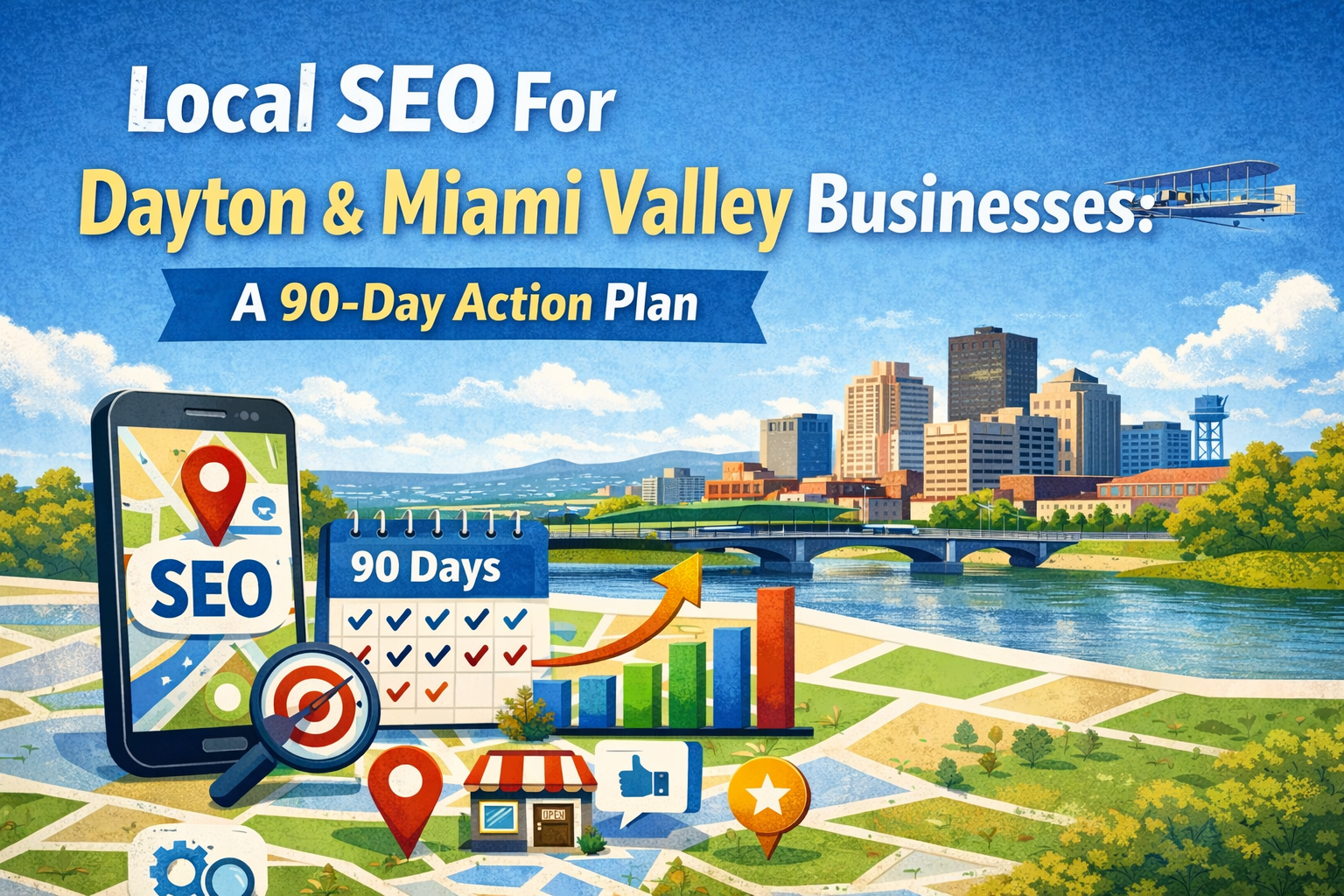
Local SEO is the fix when your Dayton or Miami Valley business is invisible in Google and AI results, and you can make real progress in 90 days with a clear weekly plan.
Why Local SEO Matters More Now
46% of all Google searches have local intent, which means nearly half of searches are people looking for nearby products and services. Around 8 in 10 consumers search for a local business online at least once a week, often using Google Search or Maps.
Up to 40% of local business queries already trigger AI Overviews, so AI summaries are starting to decide which local businesses get seen first. If your business is not properly optimized, those AI and map results will feature your competitors instead of you.
What “Not Being Found” Really Looks Like
If any of this sounds familiar, you have a local SEO problem:
-
You search your own core terms like “plumber in Dayton” or “roofing near Tipp City” and never see your business.
-
Your Google Business Profile gets very few calls or direction requests.
-
New customers keep saying, “I didn’t know you were here.”
Most small businesses still do not actively optimize for local search and only a minority have a real local SEO plan, which is why the ones that do tend to win.
The 90‑Day Local SEO Action Plan
This plan is written for Dayton and Miami Valley small business owners who want a simple, do-this-each-week roadmap, not theory.
Month 1: Fix Your Foundation
The goal in Month 1 is simple: clean up the basics so Google and AI know who you are, what you do, and where you are.
Week 1: Lock In Your Google Business Profile
Your Google Business Profile (GBP) is your new homepage in local search and AI Overviews. Customers are far more likely to trust you if they see a complete Business Profile.
Do this in Week 1:
-
Claim and verify your Google Business Profile.
-
Make sure your Name, Address, Phone, and website (NAP) are accurate and match your website.
-
Pick the most accurate primary category and a few supporting categories.
-
Add real photos of your storefront, team, and work. Aim for at least 10 to start.
This profile feeds both the local map pack and AI systems that build local summaries for “best” or “near me” queries.
Week 2: Fix Your Website Basics
Local SEO does not work if your website is slow, confusing, or missing local signals.
Focus on one primary local page first, such as your homepage or a “Service + Dayton” page:
-
Put your main keyword and city in the title tag, such as “Plumbing Repair in Dayton, Ohio | [Your Brand].”
-
Add your city and service area in your H1 and in the first paragraph.
-
Make sure your phone number is clickable and visible on mobile.
-
Add your full address and service area in the footer and on a Contact page.
Local landing pages with clear localized content consistently outperform generic pages in local search.
Week 3: Clean Up Your Citations
Citations are online listings of your business name, address, and phone across directories like Yelp and YellowPages.
Inconsistent listings confuse Google, especially when AI is stitching together data from different sites.
This week:
-
Search your business name and old phone numbers in Google.
-
Claim and correct your main listings (Yelp, Facebook, Apple Maps, Bing Places, YellowPages).
-
Make sure NAP matches your website and GBP exactly.
Week 4: Start a Simple Review System
Most consumers say they regularly read online reviews when researching local businesses, and AI uses review content heavily when choosing which businesses to highlight.
Create a repeatable process:
-
Train staff to ask happy customers for a review right after a good experience.
-
Email or text them a direct link to your Google review form.
-
Reply to every review, good or bad, within a few days.
Even 2 to 3 new reviews a week can change your visibility over a few months.
Month 2: Build Local Authority & Content
Month 2 is about sending strong signals that you are a trusted local option in Dayton and across the Miami Valley.
Week 5–6: Create or Improve Your Service Pages
AI Overviews and organic results both pull from clear, detailed service pages.
Pick your top 3 to 5 services and create individual pages that each include:
-
The service name plus city in the title and heading, like “Furnace Repair in Huber Heights.”
-
A short, plain-language description of the service.
-
Who it is for, common problems, and what makes your approach different.
-
A call to action: phone, form, or booking link.
Pages with localized content and structured information tend to outrank generic “Services” pages for local intent searches.
Week 7: Add a “Service Area” or “Locations” Page
If you serve multiple cities in the Miami Valley, say it clearly in one place.
Your Service Area page should:
-
List all cities and neighborhoods you serve (Dayton, Tipp City, Troy, Vandalia, etc.).
-
Include a short paragraph that mentions key services and “near me” style phrases in natural language.
-
Link to your main service pages.
This type of page helps both Google’s normal rankings and AI systems that look for clear, structured data about where you work.
Week 8: Publish One Helpful Local Blog Post
You do not need to publish daily. You do need at least one strong, useful post aimed at local search and AI.
Ideas that tend to perform well:
-
“Homeowner’s Guide to Preparing Your HVAC for Winter in Dayton.”
-
“Top 7 Questions to Ask a Roofing Contractor in Miami County.”
-
“How Much Does Lawn Care Cost in the Dayton Area in 2026?”
Write it in plain English, answer real questions, and mention relevant local areas naturally. AI Overviews often cite pages that answer specific questions clearly.
Month 3: Optimize for AI, Voice, and Ongoing Growth
Month 3 is about aligning with how people actually search now: on phones, by voice, and inside AI answers.
Week 9: Optimize for “Near Me” and Voice
A large share of people who do a local search on their phone visit or call a business within a day. Voice and “near me” searches are a big part of that behavior.
Adjust your content to match how people speak:
-
Add short FAQ sections on key pages with questions like “Do you offer emergency plumbing in Dayton?”
-
Answer each FAQ in one or two clear sentences.
-
Include phrases like “near Dayton,” “in Tipp City,” and “across the Miami Valley” where it sounds natural.
Voice searches often mirror these conversational questions and AI uses that Q&A structure as input for its answers.
Week 10: Use Google Posts and Photos
Active profiles tend to get more engagement and feed more data into Google and AI systems.
Once per week:
-
Add a Google Post with a short update, offer, or tip, plus a call to action.
-
Upload 3 to 5 new photos of jobs, staff, or your storefront.
A verified profile with regular activity often sees more clicks and interactions from search and Maps.
Week 11: Track What Is Working
You cannot improve what you are not measuring.
At minimum, check these once a month:
-
Google Business Profile Insights: calls, website clicks, and direction requests.
-
Organic traffic and top pages in Google Analytics.
-
Number of reviews and average rating across Google and major platforms.
High-performing local businesses track rankings, leads, and profile actions, then adjust content and listing details based on what works.
Week 12: Decide Your Next 90 Days
By the end of 90 days, you should see movement in map rankings, profile actions, and calls if you have followed the plan.
Your options for the next 90 days:
-
Double down: create more service pages and local guides that answer specific questions.
-
Expand reach: build pages or content focused on new cities or suburbs.
-
Get help: many small businesses outsource all or part of local SEO once the basics are in place.
How This Helps With AI Searches
AI Overviews and other AI search tools pull from:
-
Strong, complete Google Business Profiles.
-
Clear, localized service and location pages.
-
Detailed, trustworthy reviews and Q&A content.
Being cited in an AI summary is a sign that Google trusts your content and can send more qualified traffic back to your website and profile. For a Dayton or Miami Valley business that has been invisible, this 90‑day plan gives you a realistic path to finally show up where your customers are actually searching.